Dallas–Fort Worth · Corridor guide

Find Your Direction in DFW.

The Metroplex is a network of distinct daily lives. Use this guide to decide which direction deserves your next hour of research.

The Dallas skyline viewed across the Trinity River corridor
Dallas · the central reference point

Get Your Bearings

Two Cities.
A Region of Connections.

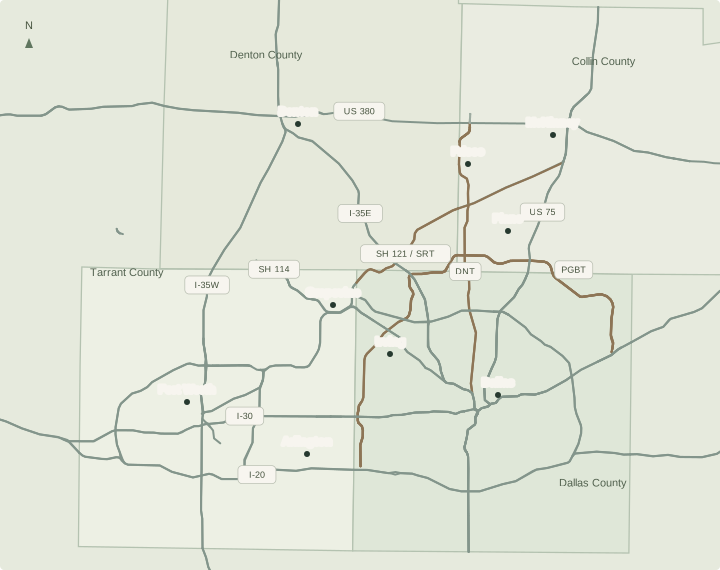
Dallas and Fort Worth anchor different sides of the Metroplex. Irving, Grapevine, and Arlington sit between them; Plano, Frisco, McKinney, and Denton extend the view north.

An overview of city reference points, four county boundaries, and selected major roads. Check an exact address and current route conditions separately.

Map locating Dallas, Fort Worth, Arlington, Irving, Grapevine, Plano, Frisco, McKinney, and Denton along selected DFW highways
Geographic overview · Data retrieved October 14, 2026 · US Census; © OpenStreetMap contributors. Map Sources & Data
Open Full-Size MapOpens a separate view for a closer look.
Read the Map as Text

Dallas is east of Fort Worth. Arlington lies between them to the south of the airport communities. Irving and Grapevine sit in the central airport area. From Dallas, Plano, Frisco, and McKinney extend north; Denton is northwest of those cities. I-30 connects the Dallas and Fort Worth corridor; I-35E and I-35W approach the north from each city. The diagram labels selected highways rather than every possible route.

Four starting lenses

Four Directions, With Specific Questions.

Each corridor can contain several very different neighborhoods. These lenses are meant to focus the next question, not make the decision for you.

01

Dallas Core & East

Compare established neighborhoods in Dallas and the eastern side of the region. Housing age, lot size, parking, street pattern, and access vary within a single area.

Worth CheckingTest the actual route and property details. An address near a destination can still have a different daily travel pattern.
Search Dallas homes ↗
02

The North Corridor

Plano, Frisco, and McKinney offer established neighborhoods as well as newer construction. Compare the specific home’s age, maintenance needs, HOA terms, tax districts, and the development around it.

Worth CheckingCompare the full monthly cost of a resale and a new build, including taxes, insurance, dues, and any builder incentives.
Search a north-corridor starting point ↗
03

Fort Worth & West

Start with Fort Worth, then decide how far west the search should extend. Historic neighborhoods, established subdivisions, and newer construction call for different questions about upkeep, setting, and access.

Worth CheckingLook at the home’s condition and the trips you repeat. More distance or more space can change both the budget and the day.
Search Fort Worth homes ↗
04

Airport & Mid-Cities

Irving, Las Colinas, Grapevine, Euless, and Bedford are useful starting points when destinations span the region. Compare each address’s road access, flight-path exposure, and surrounding uses in person.

Worth CheckingVisit at the times you expect to be home, and test your route to the airport terminal or workplace you actually use.
Search a mid-cities starting point ↗

01Route

Work, school, airport, family, and the trips you repeat.

02Pattern

Established, evolving, master-planned, urban, or more open.

03Home

The property type and setting that make the tradeoff worthwhile.

04Next step

A focused search, a tour loop, or a better question.

Once a direction feels right

Make the search specific enough to be useful.

We can turn a corridor preference into a short list of cities, neighborhoods, property types, and questions worth testing in person.

Open move planning